February 5, 2026

Local Journalism Task Force releases final report
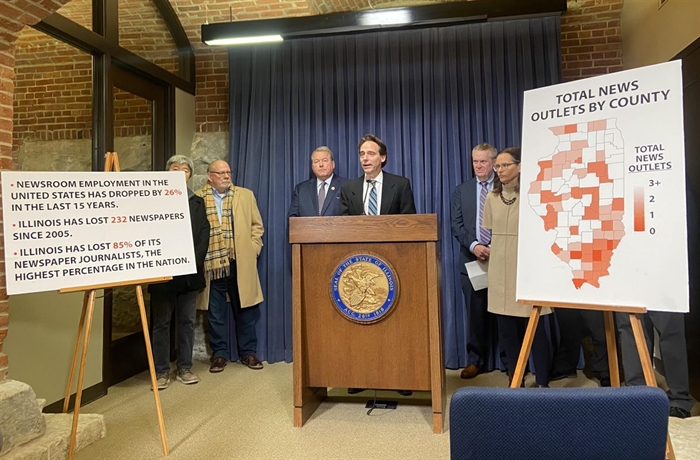
Sen. Steve Stadelman, D-Rockford, introduces the final report of the state’s Local Journalism Task Force. It details a decline of local news coverage throughout the state but proposes ways the legislature can support newsrooms. (Capitol News Illinois photo by Alex Abbeduto)

By Jenna Dooley, INBA Immediate Past President

It may seem very meta (or perhaps even Meta?!) to talk about journalists reporting on journalism in the digital age, but here I go. The Illinois Local Journalism Task Force submitted its final report and I want to share both the report itself and some of the coverage surrounding it.

As you may recall, the task force was convened by Sen. Steve Stadelman, a former news anchor who wanted to study the rapid rise of news deserts across our state and research possible solutions to introduce in the public sphere and through possible legislative action.

When INBA first learned that state government was talking seriously about potential policies affecting our industry, we asked to be at the table since our members feel the effects of this crisis deeply in our daily work.

After several months of public meetings, members of the task force decided a research-based approach would be the most appropriate way to synthesize the information we gathered. The report seeks to provide a menu of policy options, laying out pros and cons of each with cost estimates and general parameters for who should (or should not) qualify.

I cannot predict the political viability of any individual recommendation. There are some recommendations you may personally think have merit and others you may wholly disagree with depending on your philosophy related to policy and journalism. But I think INBA as an organization should take the time to weigh each on its own merits if/when they take the form of legislation. We have a history of advocating publicly on issues involving the practice of news gathering and protection of the First Amendment.

It was an honor to serve on behalf of INBA in this capacity and the perspectives you shared with me greatly helped inform my approach.

Here is some coverage related to the release of the report.

Northwestern University’s Local News Initiative

The Pantagraph

Video of the news conference:

Here is the statement I read during the press conference:

My name is Jenna Dooley.

I represent the Illinois News Broadcasters Association.

We are a non-profit organization that trains and supports broadcast journalists and educators around the state.

Many of our reporters serve in downstate markets, often in news deserts. It isn’t easy work, but it lies at the cornerstone of a healthy democracy.

We are aware of the challenges facing our industry.

These recommendations focus on a range of possible solutions.

I work in both the newsroom and the classroom and there is a lot of talent in our Illinois pipeline. Our state’s news outlets offer some of the best hands-on training out there dedicated to ethical and innovative journalism. I believe that is worth additional investment.

These recommendations acknowledge the crisis, while connecting a few dots on the assets and opportunities in front of us as a state.

I am eager to see how these recommendations are received and what additional ideas they generate.

Thank you.

Ryan Denham
Digital Content Director, WGLT (Normal)

I recently attended my first INBA conference—and it won’t be my last. The combination of professional and student journalists learning together is electric. Everyone learns from each other and walks away with new friends (and LinkedIn connections). I know I did.

Aaron Eades
Former Morning Anchor at WCIA-TV, Champaign

As a student, it's often difficult to picture what working in the real world will be like. For me, the INBA bridged that gap by giving me the chance to talk to professionals who used to be in the same shoes I'm in now.

Bob Roberts
Retired, WBBM-AM, Chicago

INBA is as much about friendship and as it is about achieving common goals. It provides two things individual newsrooms cannot: in-service training, and the ability to speak out on issues affecting the profession. But most of all, it brings newspeople together.

Alexis McAdams
Fox News National Correspondent

INBA played a huge part in preparing me for my broadcasting career. The INBA conventions connect students with on-air talent and news directors who give feedback on now to improve your work. Through relationships I made at those conventions, I was able to obtain my first on air reporting job.

Mike Miletich
Capitol Bureau Reporter, WAND-TV, Decatur

Joining the INBA was one of my best life decisions. I met some of the best broadcast journalists while I was still a college student. Plus, I ended up getting a job through the connections I made!

Andrew Tanielian
Freelance Video Journalist

INBA taught me how to network in a meaningful way. The scholarship process taught me how to endure a hard job interview and thrive.

Jeff Bossert
Morning Edition Host, WVTF, Roanoke, Virginia

When I was working in radio for the first time, I had no idea whether I could truly handle the demands. But INBA made me curious and want to improve. Even now, when I’ve maybe worked a lot of hours or planned some stories that didn’t come together for one reason or another, what I learn from an INBA conference gets me re-invigorated about the business.

Michelle Eccles McLaughlin
Public Relations Account Manager, Horace Mann Insurance

INBA is an organization that really caters to continuing education for professionals. It offers a relatively inexpensive way to learn new things, reinforce best practices and network.

Molly Jirasek
News Director, ABC57, South Bend, IN

One of my top goals in my career was to get to Chicago. Thanks to INBA I met Margaret Larkin. She remembered our great conversations about Chicago and first alerted me to a job opening in the city I might be interested in. Lo and behold, I got that job! INBA helped me reach my dream.

Jennifer Fuller
Assistant Director of Legislative Affairs, John A. Logan College

INBA is not only a great networking tool, it also provides advocacy and support for journalists in an ever-changing world.

Nora Baldner
Professor, Quincy University

The support INBA gives to student journalists is vitally important as we all discover how technology is changing news dissemination, INBA monitors and actively encourages truth, transparency and accountability from students and their universities.

Leave a Reply